Cumberland Council: local authority assessment
Downloads
Overall summary
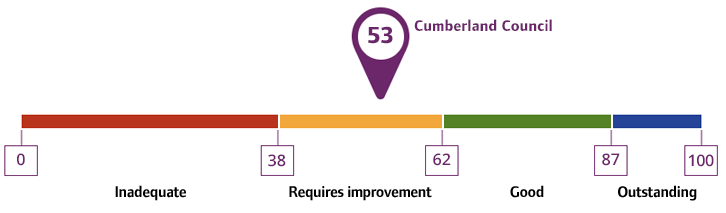
Local authority rating and score
Quality statement scores
Summary of people's experiences
Unpaid carers were happy with the support they received from the commissioned carers service, but most carers found their caring roles challenging and time consuming. Most carers did not get access to breaks, with respite access more limited in some areas. Contingency planning for emergency breakdown of support was not always in place.
Some people experienced waits for assessments, annual reviews, occupational therapy assessments, equipment delivery, financial assessments and outcomes of Deprivation of Liberty Safeguards assessments. Despite this, those at most risk were supported in a timely manner through waiting well procedures. Steps were being taken to reduce waits for people, with decreased waiting lists for annual reviews, for example.
Most people were satisfied with their care and support and felt they had control over their daily lives. Some people’s access to services was dependent on where they lived, with local provision more difficult to access in areas of Cumberland.
People and unpaid carers felt safe and people could access out-of-hours support for urgent support if they needed it. Most people had their outcomes met when subject to safeguarding enquiries. People could access statutory advocacy and were satisfied when they received it, but sometimes access was delayed depending on urgency of need.
People accessed reablement and intermediate care beds to support their independence following hospital discharges, but national data suggested pathway use and outcomes for people could be improved. Some people could experience increased handoffs between different services following discharges, due to delays setting up long-term care and support. People could be delayed from being discharged from specialist mental health hospitals due to a lack of available care provision.
People and unpaid carers were being involved more in co-production as the local authority developed its approach. The carers forum, living well-sub-group and community panels were supporting people to have a voice and be listened to.
People were supported to access interpreters, but this could be more challenging for some people depending on their needs. Accessible information such as easy-read information was not always available. People with sensory impairments were supported effectively.
Young people were safely supported to transition from children’s services to adult social care and most people told us their experiences were positive.
Summary of strengths, areas for development and next steps
The local authority understood its areas for development following Local Government Reorganisation (LGR) and was on an improvement journey. A wide-ranging transformation plan was ongoing and as a result the impact of this work was still embedding. Resources had been allocated to improve services, but the impact of this was not yet always evident. The local authority had a commitment to learning, through external reviews and when things go wrong. Coproduction was being better developed, with some positive examples using people’s voice. Strategies were being developed across the service.
There were staffing pressures across areas of the service, and this could impact how services were delivered. The local authority was using agency staff to support areas of the service, but these staff were not always local. Staff were supported effectively by managers to manage their workloads.
Unpaid carers found their roles challenging and most did not have time for themselves. Most carers did not access services to allow them to take breaks and respite provision. A commissioned service was supporting with a range of services, and most carers were positive about this support. A carers forum was embedding to support improvements to carer support.
Partners and carers told us contingency planning was not always in place, but staff told us they understood the importance of contingency arrangements.
There were significant waits for OT assessments and equipment. Equipment provider services were being reviewed in response to challenges. Risk was being mitigated for people waiting and there had been some improvement in equipment delivery rates. Mobile and static clinics were supporting some people to access assessments. Disabled Facilities Grant authorisations for home adaptations were timely.
There were some waits for assessments and long waits for annual reviews. Resources had been prioritised to reduce waits for people, but impact was still embedding. A Waiting Well Procedure was supporting people at most risk to be supported in a timely manner.
Person centred practice was being supported by a Practice Framework but there was opportunity to apply holistic and personalised approaches more consistently. There were positive examples of staff supporting people in personalised and creative ways to better outcomes. Direct payment uptake was recognised as an area for development.
A transfer of care hub supported integrated hospital discharge arrangements. Reablement and intermediate care pathways were supporting independence but there was opportunity to improve long-term outcomes following reablement. The local authority had increased intermediate care bed capacity and usage was increasing. There was opportunity to review overlapping pathways and resources with health as well as the opportunity to reduce handoffs for people following stays in hospital.
The local authority was developing its commissioning approach, with a new Adult Social Care and Housing Commissioning Strategy which was due for sign off. Specialist services, housing with care options and day opportunities were particularly difficult to access for some people. A lack of local services could create delays in discharges from, for example, specialist mental health hospitals. The local authority understood its market and was taking steps to improve provision such as through the new day opportunities framework.
In-house services were being reviewed to support efficiency and their suitability, alongside market need. Care providers faced sustainability challenges through recruitment and financial pressures. Care provider quality assurance work was mitigating risk.
The local authority recognised the need to engage better with seldom-heard communities. The geography of Cumberland was a key barrier in accessing local services for some people. The local authority had identified seldom-heard groups and communities and was developing their approach to engagement. Trauma-informed and inclusive practice was central to the Practice Framework. Interpreter and accessibility arrangements were not always consistent.
The local authority recognised a need to strengthen prevention. There was investment in the pre-front door and front door and there were early signs of impact. There was a need to improve the information and advice offer and the local authority was developing self-serve options. The health and wellbeing coaches (HAWCS) were a positive example of supporting a preventative approach, offering people flexible and empowering support.
Leaders were visible and accessible for staff. Staff were supported effectively with their continuous professional development (CPD) and new staff benefitted from targeted training.
The local authority had developed positive working relationships with key partners, supported by place-based arrangements. The Better Care Fund was being used to support better outcomes for people and was monitored effectively. Voluntary, Community and Social Enterprise (VCSE) partners were involved on strategic boards, but some partners felt more listened to than others.
Young people were supported effectively to achieve positive outcomes following transition to adult services. However, staffing pressures could impact on consistency of approach.
Safeguarding processes had been adapted following a bespoke peer review to help keep people safe. Decision making was timely, and enquiries were completed with a more person-centred approach. There was opportunity to provide improved guidance and training for partners around safeguarding. Outcomes of enquiries were not always communicated effectively.
There was a significant DoLS waiting list, with long waits for authorisations for some people. This left people at risk of being deprived of their liberty unlawfully. A prioritisation tool was supporting risk rating of applications and people at the highest risk to be reviewed first.